


The SRE agent that shows its work.
Verdict is an autonomous SRE agent for Kubernetes. Investigation-first: every alert gets a root-cause report with the evidence cited. Read-only by default: fixes ship only as pull requests a human approves, and the agent verifies the result after merge.
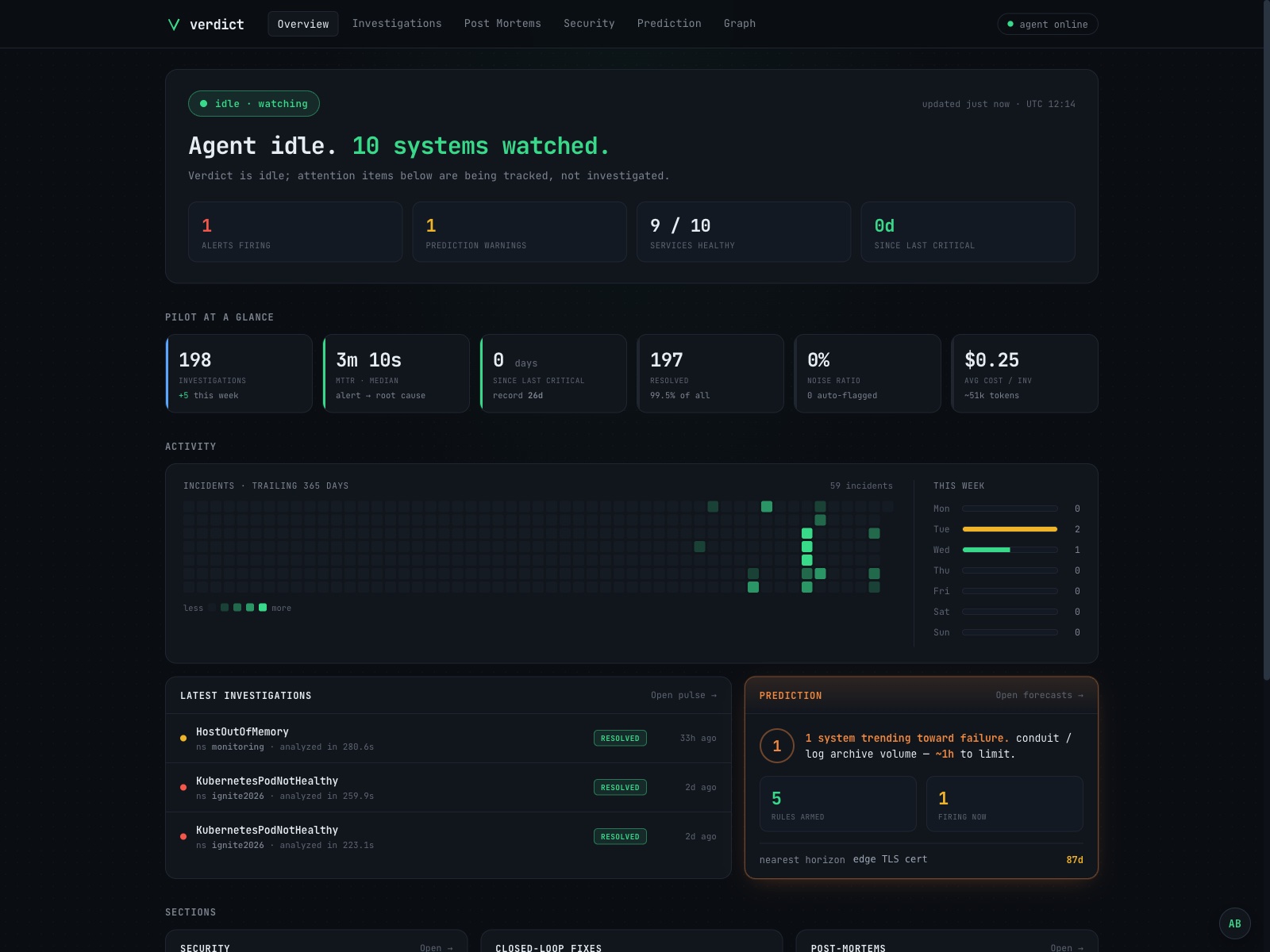
Overview: the whole cluster on one page.
Agent status, alerts firing, prediction warnings, services healthy, days since last critical. A 365-day incident heatmap keeps the year honest. Everything refreshes every 15 seconds.
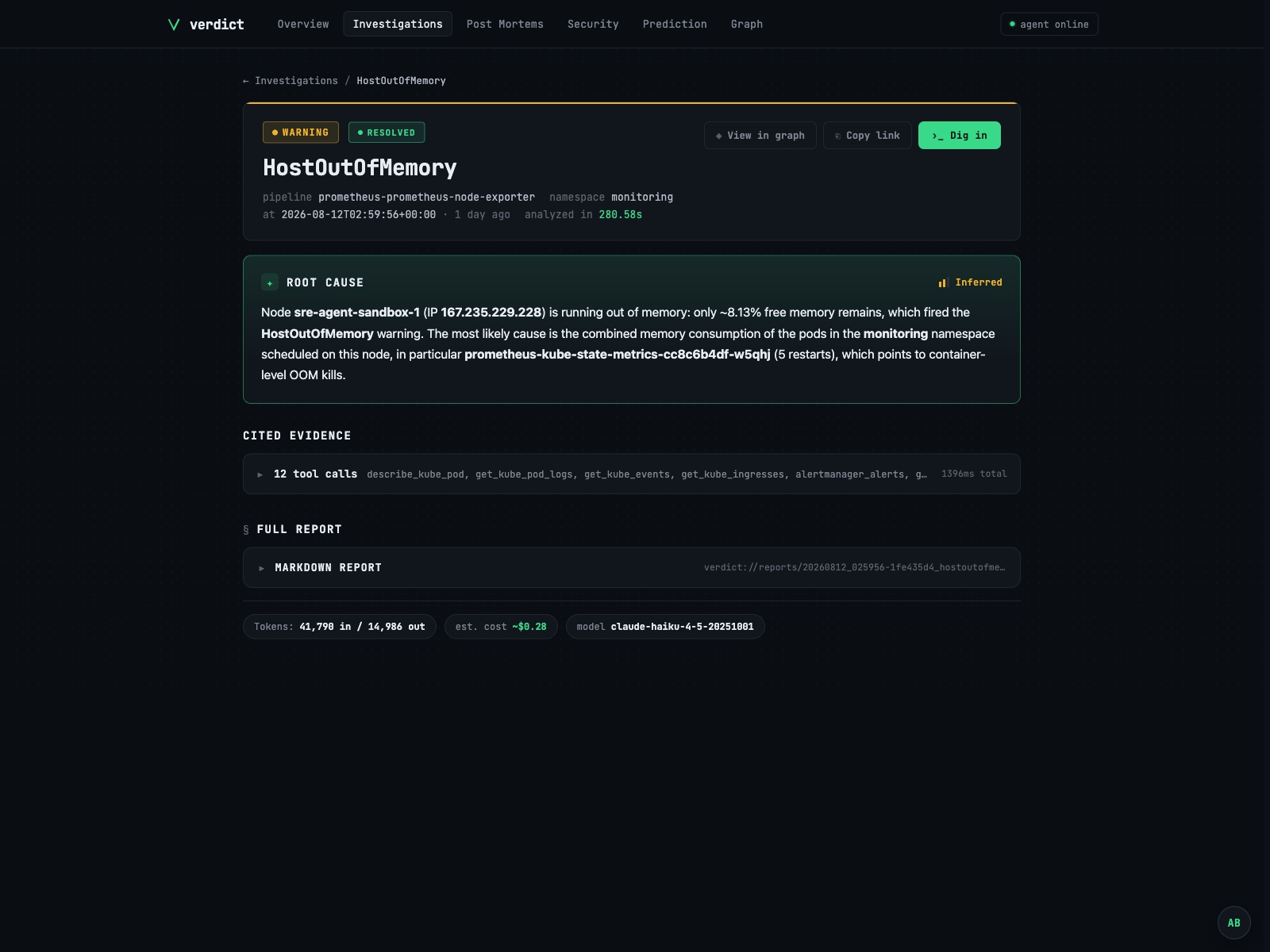
Investigations: root cause before anyone gets paged.
Every alert spawns an investigation automatically. The agent queries Kubernetes, Prometheus, Argo CD and GitHub, runs hypotheses in parallel, and posts a report where the conclusion cites its evidence: the actual tool calls behind it. A “Dig in” chat lets the on-call engineer interrogate the agent. Auto-triage, severity filters, noise hiding.
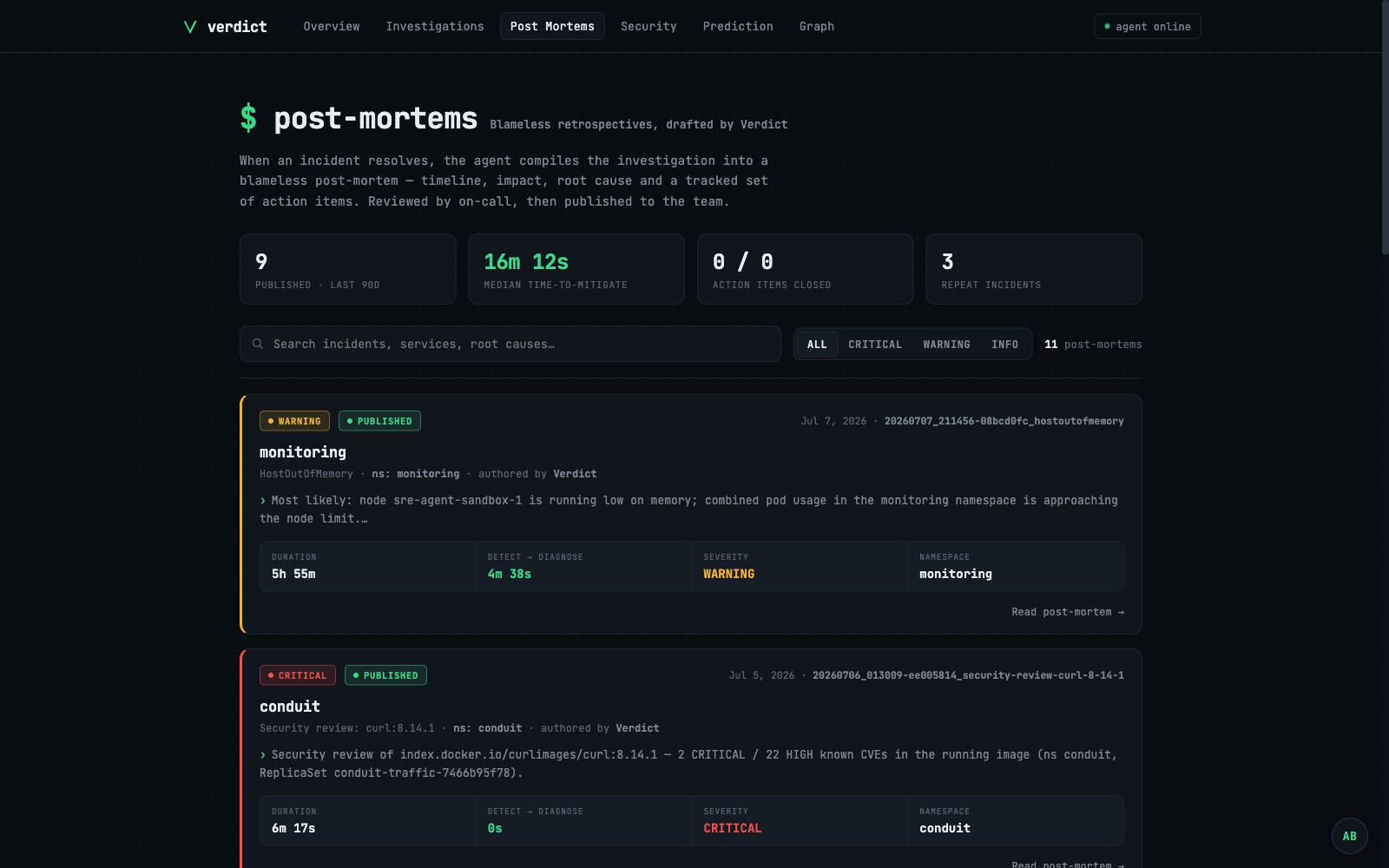
Post-mortems: drafted by the agent, owned by the on-call.
When an incident resolves, the agent drafts the post-mortem: timeline, impact, root cause, tracked action items. The on-call engineer reviews, then publishes. Median time-to-mitigate and repeat-incident tracking come with it.
Security: ask what a CVE means for your setup.
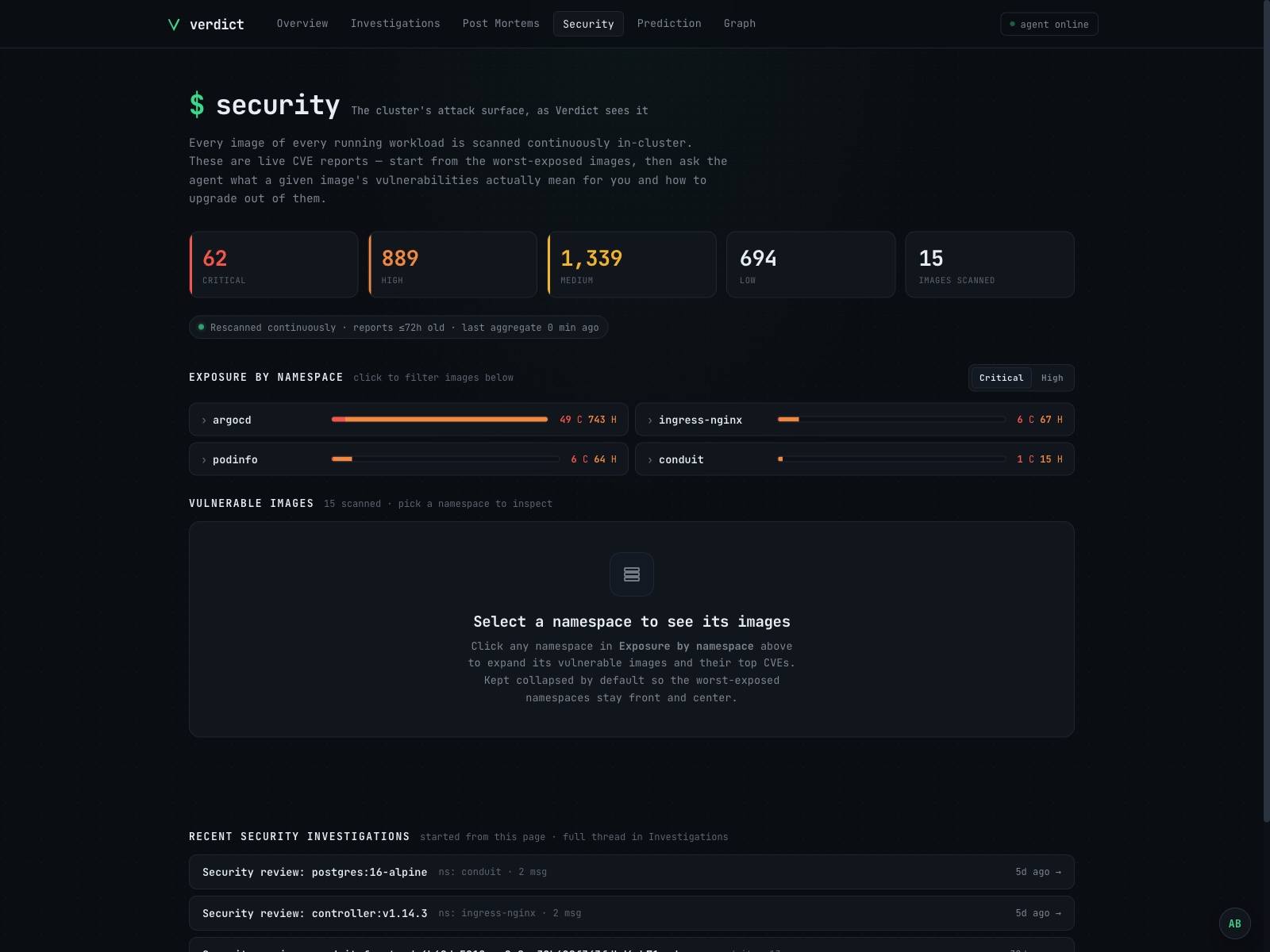
Every image of every running workload is scanned continuously, in-cluster. Live CVE reports by severity, exposure by namespace, rescans within 72 hours. The differentiator: security reviews are investigations too. You can ask what a CVE actually means for your setup and how to upgrade out of it.
Prediction: investigate the incident that hasn’t happened.
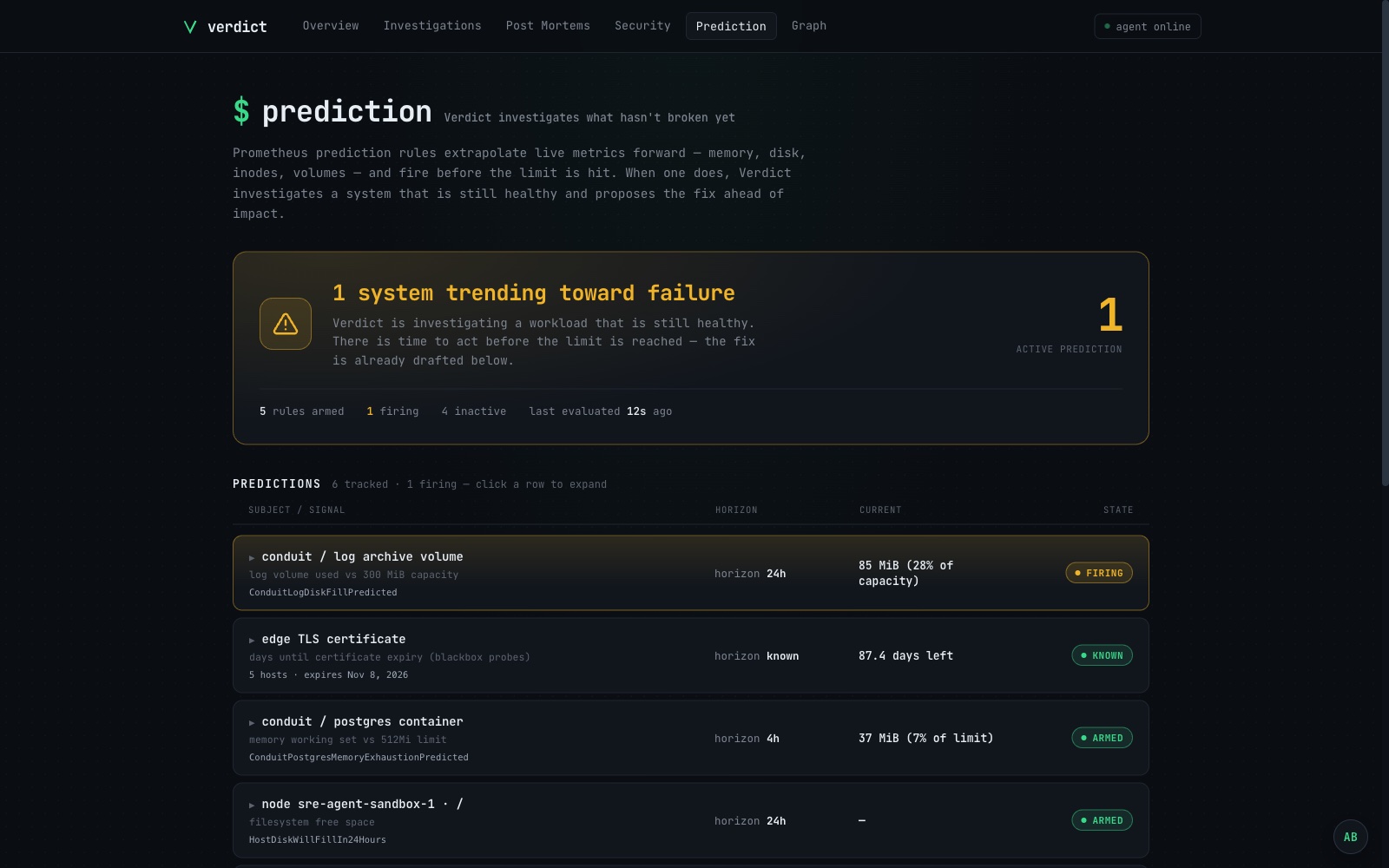
Prometheus prediction rules extrapolate live metrics forward: memory, disk, inodes, volumes. The alert fires before the limit is hit, so Verdict investigates a system that is still healthy and drafts the fix ahead of impact.
Graph: the agent’s memory, made visible.
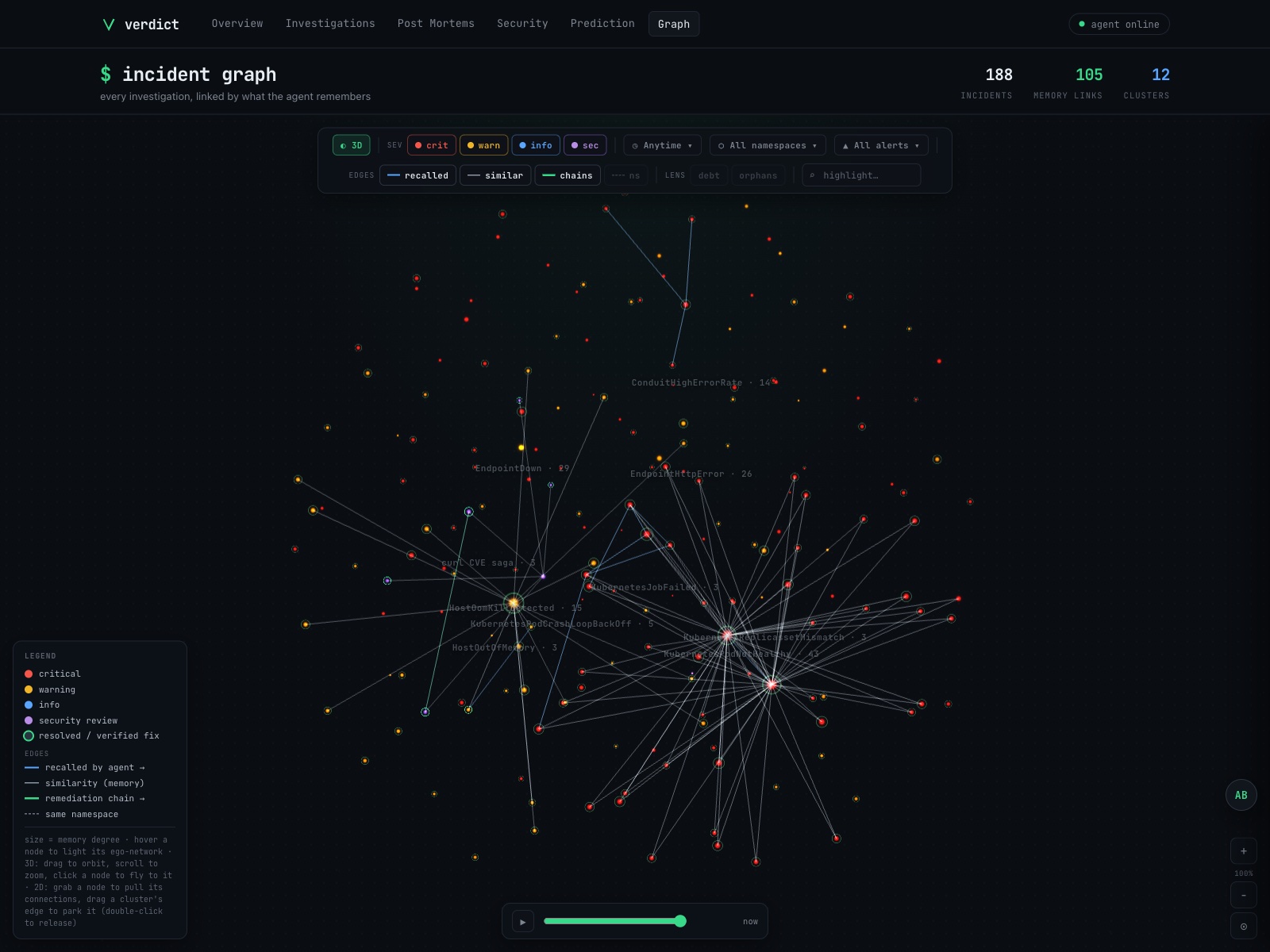
Every investigation is a node; edges show what the agent recalled while working: memory links, similarity, remediation chains. Lenses surface technical debt and orphan incidents. This is the proof the agent learns your cluster instead of starting cold each time.
Read-only by default. Fixes ship only as pull requests a human approves. After merge, the agent verifies the result: closed-loop remediation. Every investigation shows its cost.
What does Verdict touch in production?
Nothing directly. Verdict is read-only by default: investigations query Kubernetes, Prometheus, Argo CD and GitHub. Any fix ships as a pull request a human approves, and Verdict verifies the result after merge.
How is this different from an AIOps dashboard?
Dashboards show you signals and leave the thinking to you. Verdict does the investigation: it runs hypotheses in parallel, cites the actual tool calls behind its conclusion, and posts a root-cause report before anyone gets paged.
What does an investigation cost?
Cost is transparent per investigation. In the pilot deployment the average is $0.25 per investigation, around 51k tokens. Every investigation shows its own cost.
Can we self-host it?
Verdict runs in your cluster: the security scanner and the investigation agent operate in-cluster. Deployment options, including fully private setups, are part of the demo conversation.
How does the memory work?
Every investigation becomes a node in a graph: memory links, similarity, remediation chains. When a new alert fires, the agent recalls related incidents instead of starting cold, and the graph makes that visible.
What happens when a hypothesis is wrong?
A wrong hypothesis costs minutes of engineer review, not an outage: conclusions arrive with cited evidence, changes only ever ship as pull requests, and the on-call engineer owns the decision.